
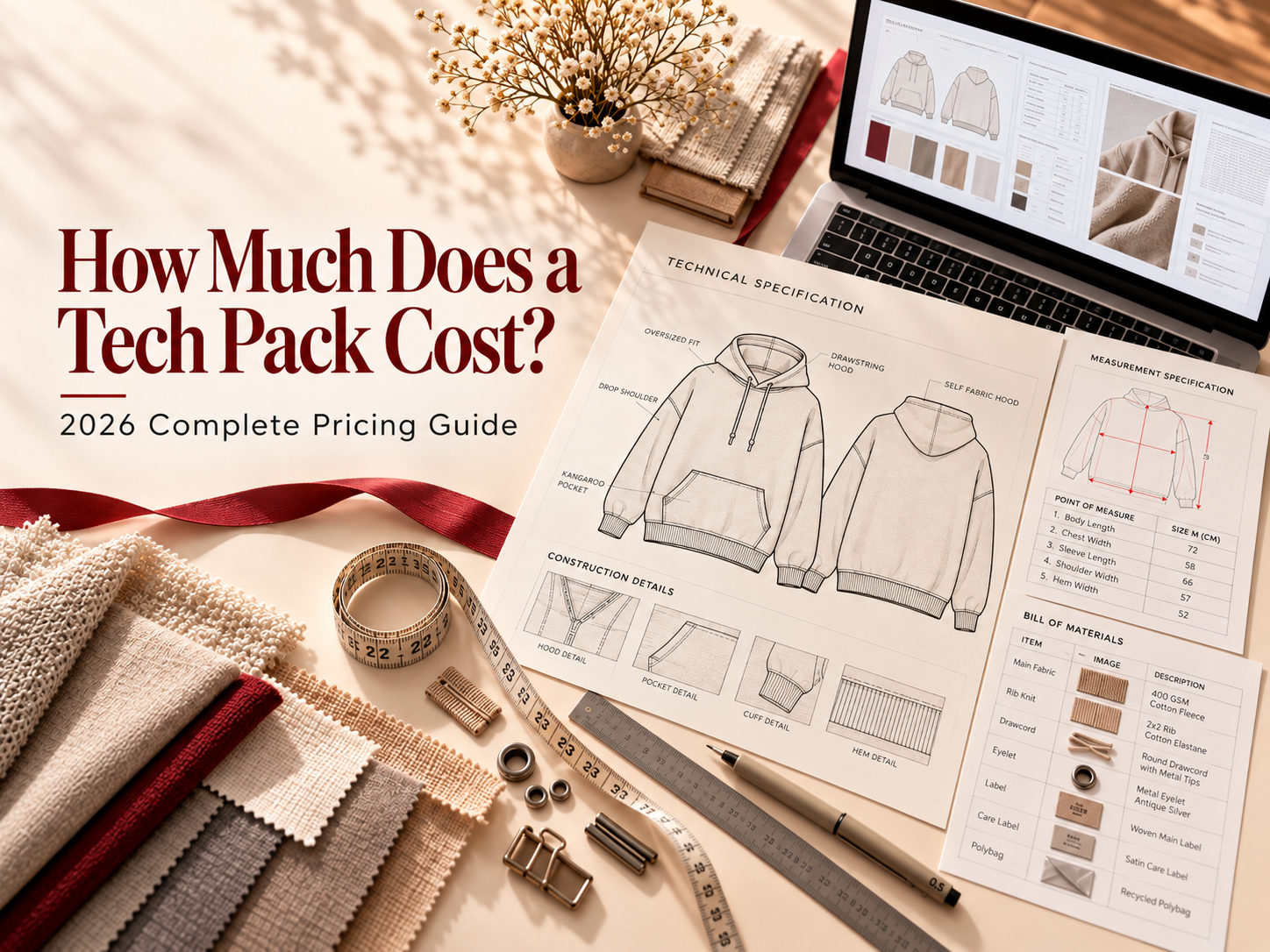
A clothing tech pack can cost less than $100 for a limited-scope service or $1,000 or more for detailed professional development. Published 2026 prices include $299 for a standard single-style package at one provider and $400–$1,000 for different garment categories at another. The final tech pack cost depends on garment complexity, technical specifications, size requirements, and included deliverables.
For clothing brands and fashion startups, the challenge isn't simply finding the cheapest designer. It's understanding what you're paying for and whether the finished documents will give your manufacturer enough information to develop your product.
This guide explains realistic tech pack pricing, what affects the cost, which services may be charged separately, and how to choose the right option for your clothing business.
How Much Does a Tech Pack Cost in 2026?
There is no universal industry price for creating a clothing tech pack.
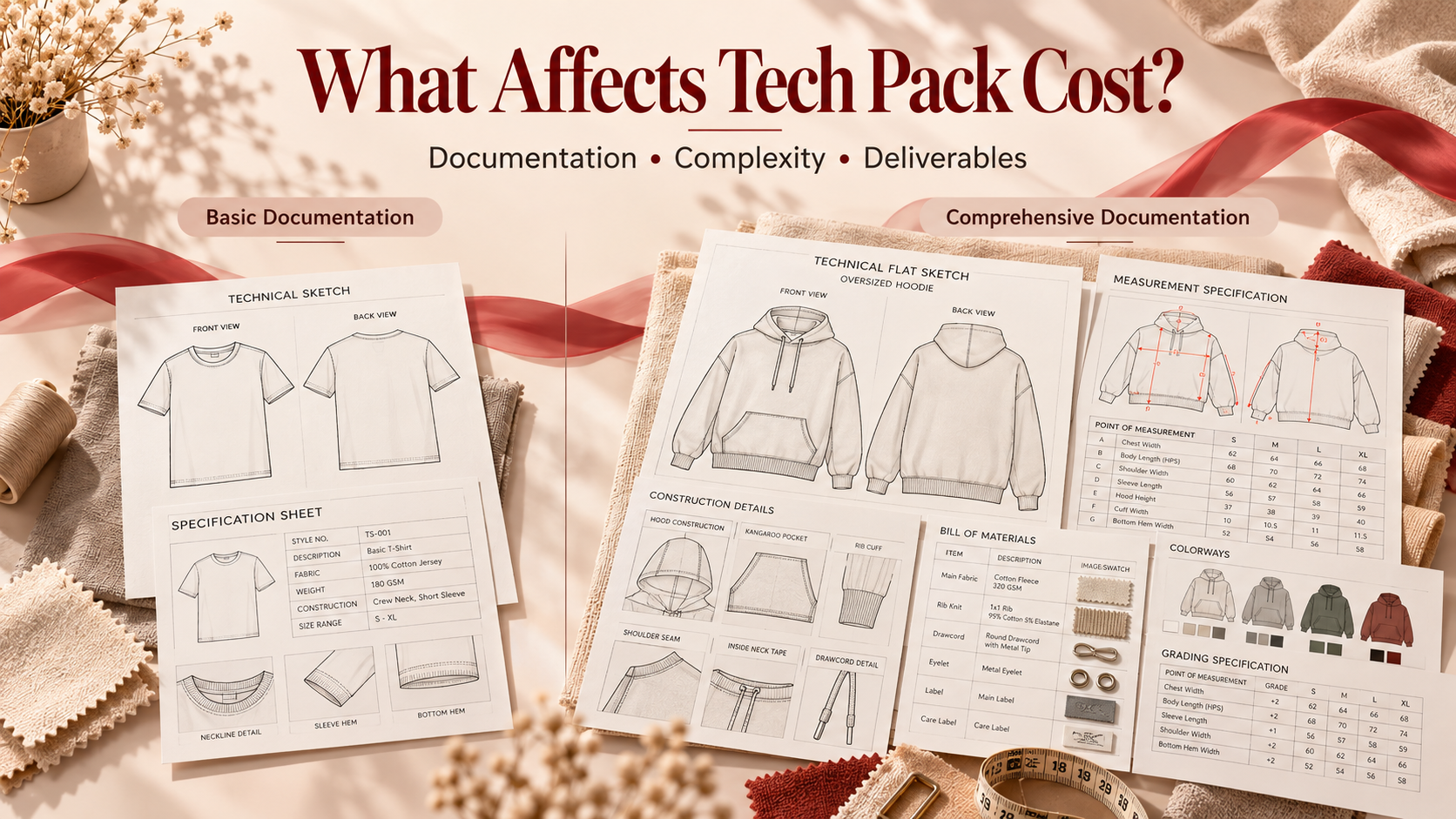
Some designers offer basic technical drawings or limited specification packages at relatively low prices. Others charge several hundred dollars for complete garment documentation containing technical flats, measurements, materials, construction instructions, and revision support.
For a practical comparison, here are some publicly advertised pricing examples from 2026:
- GarmentSpec: $299 per style for a standard tech pack, including annotated technical flats, measurement specifications, a bill of materials, construction notes, and defined revisions.
- TM Tech Packs: $400 for basic garments such as T-shirts and tank tops.
- TM Tech Packs: $600 for garments such as pants, leggings, sweatshirts, dresses, and blouses.
- TM Tech Packs: $800–$1,000 for more complex garments, including certain denim, outerwear, tailoring, and swimwear projects.
- Styliqa: Tech pack and flat sketch projects advertised from $30 per project, with the final scope and pricing determined by the service required.
You can review the published examples through GarmentSpec's pricing page and TM Tech Packs' pricing guide.
Styliqa's starting price is listed on its professional fashion tech pack design page.
These are individual providers' advertised prices, not industry-wide averages. Their packages and deliverables differ, so they shouldn't be compared as identical services.
A $50 technical drawing and a $600 comprehensive tech pack may both be reasonably priced for their intended scope.
The important question is whether the service includes the technical information your manufacturer needs.
What Is a Clothing Tech Pack?
A clothing tech pack, short for technical package, is a collection of technical documents explaining how a garment should be made.
It provides manufacturers with information about garment measurements, construction, fabrics, trims, artwork placement, and other production requirements.
Think about designing an oversized hoodie for a new streetwear collection.
You might already have a reference image showing the silhouette, color, and overall style.
But your manufacturer needs more than an image to understand what you want.
They may need to know:
- How wide should the finished chest be?
- What should the body and sleeve lengths measure?
- Which fabric composition and weight should be used?
- Should the hood have one layer or two?
- Where should the kangaroo pocket sit?
- What type of ribbing belongs at the cuffs?
- How should the seams be constructed?
- Where should the logo be positioned?
A properly prepared tech pack documents these decisions in an organized format.
For a detailed explanation, Techpacker's guide to fashion tech packs covers the main components of a technical package and their role in garment development.
If you're unsure whether you need technical drawings or a complete specification package, Styliqa's article on tech packs vs. flat sketches explains the difference.
What Is Included in a Professional Tech Pack?
Before comparing prices, it's important to understand the actual deliverables.
Not every tech pack provider offers the same level of documentation.
A basic package may include technical illustrations and limited measurements.
A more detailed package may include construction information, materials, graded specifications, and other production details.
Here are the most common components.
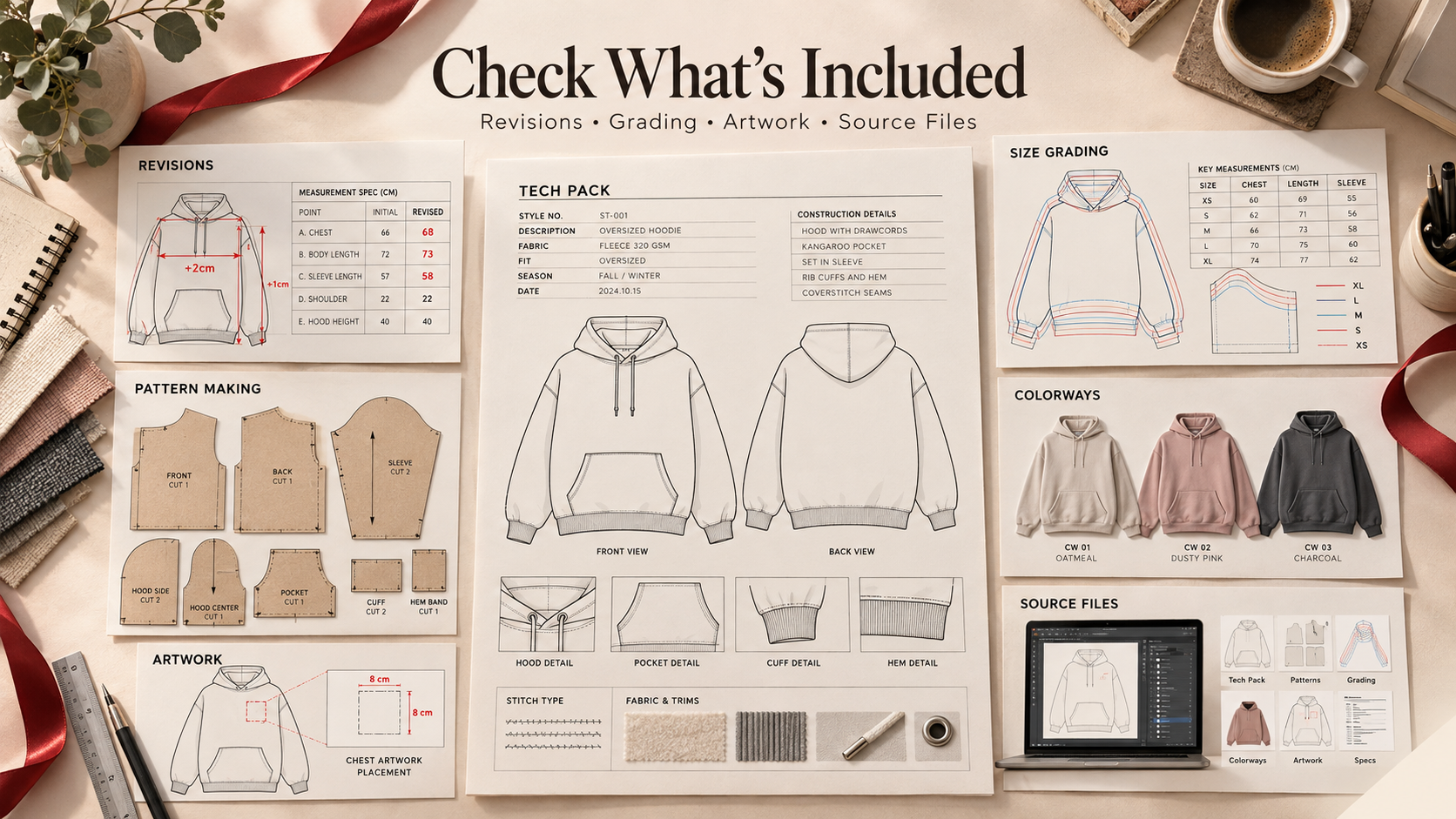
1. Technical Flat Sketches
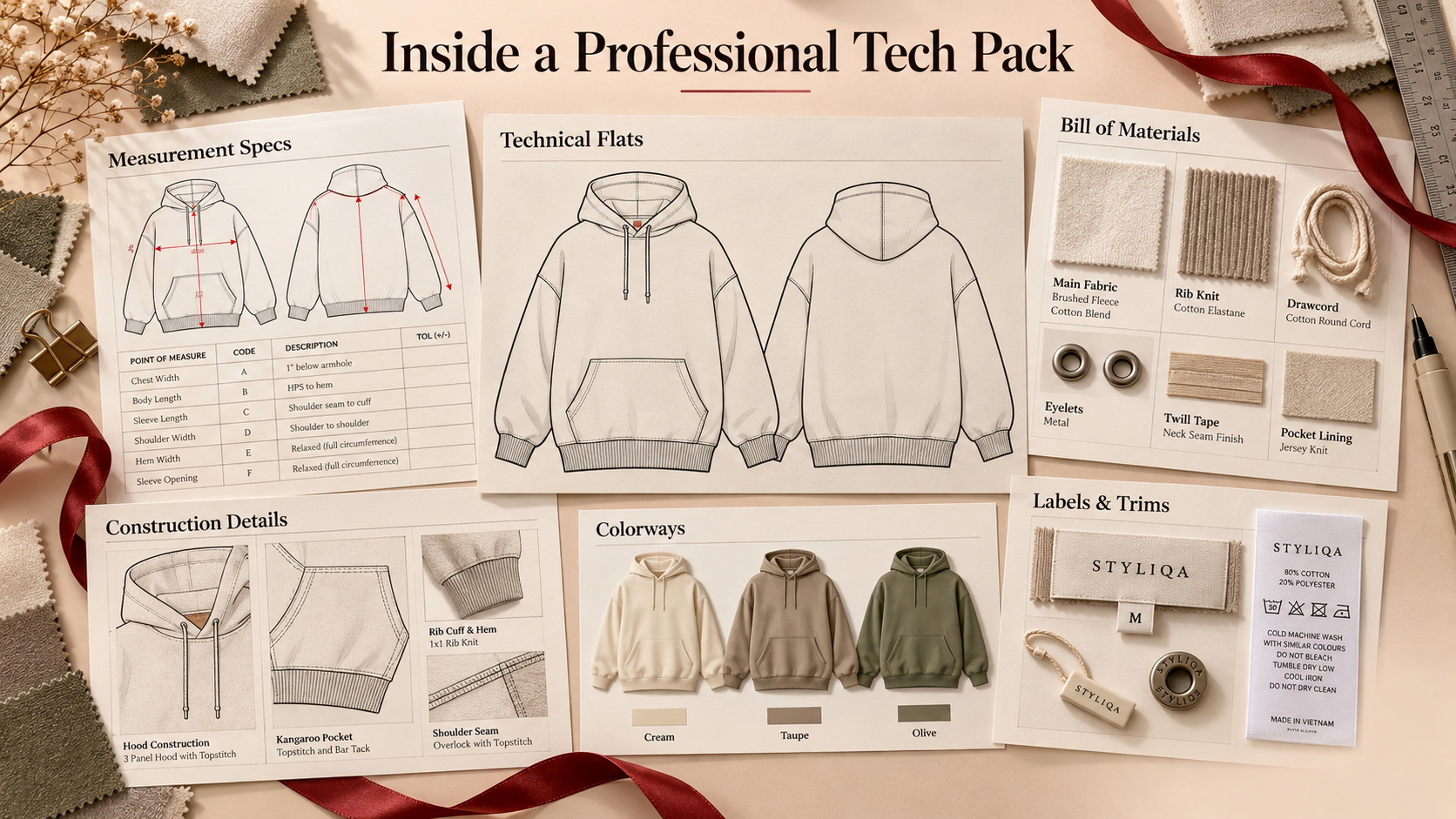
Technical flat sketches illustrate the garment's construction features.
Unlike fashion illustrations, technical flats focus on the garment itself rather than presenting clothing on a model.
They commonly include front and back views.
More complicated designs may need side views, enlarged details, or additional construction illustrations.
For example, a hoodie technical flat may identify:
- Hood construction
- Pocket shape and placement
- Ribbed cuffs and hem
- Neckline details
- Shoulder seams
- Decorative stitching
- Zipper or drawcord placement
These illustrations give the manufacturer a visual reference for the intended garment.
However, a technical flat sketch alone is not necessarily a complete tech pack.
Styliqa offers professional technical flat sketch services for brands that need garment illustrations as part of their development process.
2. Measurement Specifications
Measurement specifications define the important dimensions of the finished garment.
These dimensions are commonly called points of measure, or POMs.
For an oversized hoodie, a measurement specification might include:
- Chest width: 60 cm
- Body length: 72 cm
- Shoulder width: 58 cm
- Sleeve length: 61 cm
- Hem width: 52 cm
These are hypothetical measurements for illustration, not approved garment specifications.
A complete measurement sheet should explain how each measurement is taken.
Depending on the garment and service scope, it may also include measurement tolerances and specifications for additional sizes.
Measurements are particularly important because a small difference in fit can affect the finished appearance of a garment.
3. Bill of Materials (BOM)
A bill of materials lists the components needed to manufacture a garment.
For a hoodie, the BOM may include:
- Main fabric
- Rib knit fabric
- Sewing thread
- Drawcords
- Eyelets
- Brand labels
- Care labels
- Other required trims
Where available, a bill of materials may also specify material composition, weight, color references, supplier details, and quantities.
The purpose is to help the manufacturer identify the correct components.
4. Construction Details
Construction notes explain how different garment components should be assembled.
They may include seam types, stitch types, finishing methods, and other technical instructions.
For example, a technical drawing might show the location of a pocket.
The construction notes can explain how that pocket should be attached, including any specific stitching or reinforcement requirements.
More complicated garments generally need additional construction documentation.
5. Colorways and Artwork Placement
If a clothing design includes several colors or graphics, the tech pack may need to document those variations.
This can include:
- Garment color references
- Print placement
- Embroidery placement
- Artwork dimensions
- Trim colors
- Different colorway combinations
Production-ready artwork may be a separate deliverable from the tech pack itself.
6. Labels and Packaging
Some tech packs include specifications for brand labels, care labels, hangtags, and packaging.
These requirements depend on the product and the intended market.
For example, the U.S. Federal Trade Commission's clothing and textile guidance explains applicable labeling rules for certain textile products sold in the United States.
A technical designer can help document label placement and specifications, but regulatory compliance remains a separate responsibility.
7. Revisions and Technical Updates
Garment specifications may change during sampling.
You might decide to adjust a sleeve measurement, reposition a pocket, or change a construction detail.
The tech pack should be updated to reflect approved changes.
Before hiring a designer, confirm how revisions are handled and what qualifies as additional work.
Tech Pack Cost by Garment Type
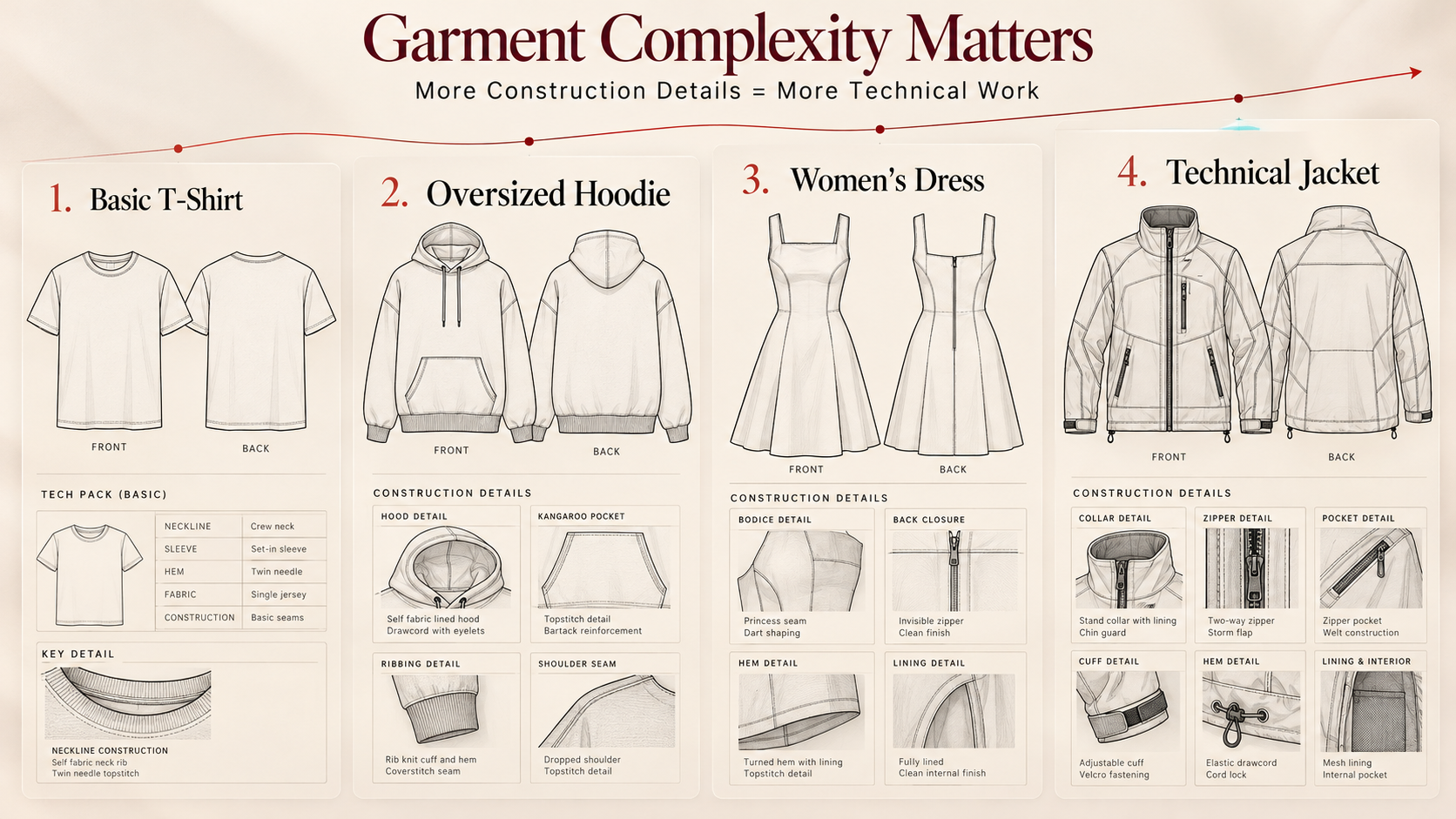
Garment complexity is one of the main factors affecting tech pack pricing.
A basic T-shirt generally requires fewer construction details than a lined jacket with multiple closures and internal components.
However, the price also depends on the provider and the documentation included.
T-Shirt Tech Pack Cost
T-shirts are often among the simpler garments to document.
A standard T-shirt tech pack may include:
- Front and back technical drawings
- Finished garment measurements
- Fabric specifications
- Neckline construction
- Stitching details
- Label placement
A basic regular-fit T-shirt may require less work than an oversized design with custom proportions, unusual seams, or detailed artwork placement.
As one published example, TM Tech Packs lists basic garment tech packs at $400.
A limited-scope freelancer service may be cheaper, but the deliverables should be compared carefully.
Hoodie and Sweatshirt Tech Pack Cost
Hoodies generally require more technical documentation than basic T-shirts.
Important details may include:
- Hood dimensions
- Hood lining or layering
- Drawcord specifications
- Pocket placement
- Ribbing construction
- Sleeve proportions
- Fabric weight
- Stitching and seam finishing
A simple pullover hoodie and a more complex zip-up hoodie may require different amounts of technical work.
For streetwear brands, accurately communicating the intended silhouette can be particularly important.
Dress Tech Pack Cost
Dress complexity varies significantly.
A simple relaxed dress may require relatively straightforward documentation.
A structured dress with lining, darts, gathering, multiple panels, or unusual closures can require more detailed technical instructions.
Fit requirements may also increase the work involved.
For brands developing dresses, the level of detail should reflect the garment's actual construction rather than its appearance alone.
Activewear Tech Pack Cost
Activewear development often involves additional considerations related to stretch fabrics, movement, and specialized construction.
A leggings tech pack may include:
- Waistband construction
- Panel measurements
- Seam placement
- Elastic specifications
- Fabric composition
- Stretch and recovery requirements where applicable
These technical requirements should be developed with the intended material and garment function in mind.
Jacket and Outerwear Tech Pack Cost
Jackets and outerwear can be among the more technically demanding garment categories.
They may involve:
- Multiple fabric layers
- Linings and insulation
- Zippers and hardware
- Internal construction
- Reinforced seams
- Several pockets
- Specialized closures
- Complex finishing techniques
These details often require more technical drawings and construction instructions.
When developing complex outerwear, relevant designer experience may be more important than choosing the lowest-priced service.
What Factors Affect Tech Pack Pricing?
Even two garments in the same category can have different technical-development costs.
Here are the factors that influence pricing most often.
Garment Complexity
More complicated garments usually require more technical decisions.
A simple sleeveless top generally requires less documentation than a tailored blazer with lining, interfacing, and specialized construction.
Additional panels, closures, trims, and technical features can increase the workload.
Number of Technical Drawings
A basic garment may only require front and back views.
A more complex design might need side views, internal details, or enlarged construction illustrations.
Each additional drawing requires preparation and review.
Design Information Provided
A clear design brief can make the development process more efficient.
Consider these two requests.
Brief A: "I want an oversized hoodie similar to this picture."
Brief B: "I need an oversized pullover hoodie with dropped shoulders, a double-layer hood, ribbed cuffs, a kangaroo pocket, and a defined base size."
The second brief provides more useful information.
It doesn't eliminate the need for professional technical decisions, but it reduces uncertainty.
Size Range and Grading
A tech pack containing only base-size measurements may require less work than a complete set of graded specifications.
If your clothing collection includes XS through XXL, the technical designer may need to establish how measurements change between sizes.
However, graded measurement specifications and actual graded sewing patterns are different deliverables.
Styliqa's guide, Pattern Grading 101: How One Size Becomes a Full Size Range, explains why proper grading involves more than simply enlarging or shrinking a garment.
Colorways and Design Variations
Multiple colors do not always require separate complete tech packs.
If the garment construction remains unchanged, color variations can often be documented within one technical package.
However, additional artwork, trims, or construction differences may increase the workload.
Revisions
Some providers include a defined number of revisions.
Others charge separately for changes beyond the original agreement.
Confirm the revision policy before accepting a quotation.
File Formats
Some providers deliver only a final PDF.
Others may include editable technical drawings, spreadsheets, or additional source files.
If you expect to update the garment later, editable files may be valuable.
Ask which formats are included and whether you can reuse the documents with different manufacturers.
Freelancer vs. Professional Studio vs. DIY Tech Pack
There are several ways to prepare a clothing tech pack.
The best option depends on your budget, technical knowledge, garment complexity, and development stage.
Creating a Tech Pack Yourself
DIY tech pack creation can be practical if you already understand:
- Garment construction
- Technical flat drawing
- Measurement specifications
- Fabric and material requirements
- Manufacturing documentation
You can use spreadsheets, illustration software, and suitable templates.
However, a free template doesn't automatically produce accurate specifications.
You still need to prepare and verify the technical information.
Hiring a Freelance Tech Pack Designer
A freelancer can be a good option for a clearly defined project.
For example, if you already have a finalized design and need technical drawings with garment specifications, a specialist freelancer may be appropriate.
Before hiring, check their experience with similar garments.
Ask to review relevant technical documentation rather than relying only on attractive fashion illustrations.
Working With a Professional Development Studio
A fashion technical-development studio may be useful when several related services are required.
A clothing collection might need:
- Technical flat sketches
- Tech pack development
- Pattern making
- Pattern grading
- 3D garment visualization
- Related production-file preparation
Working with one provider for connected services may simplify communication and technical coordination.
For brands that need this type of support, Styliqa's fashion tech pack development services provide a starting point for discussing the required deliverables.
Can AI Create a Tech Pack?
AI-assisted tools can help organize information, generate draft layouts, and prepare initial documentation.
However, generated specifications should not automatically be considered correct.
Measurements, construction details, fabric assumptions, and tolerances require careful checking.
An AI-generated document may look professional while containing technical errors.
For garments intended for manufacturing, the final information should be reviewed by someone who understands apparel development.
How Much Should a Fashion Startup Budget for Tech Packs?
If you're launching a clothing brand, calculate your tech pack budget based on the number of styles and the required technical work.
Let's consider a hypothetical streetwear collection containing five garments.
Assume the following pricing:
- Two T-shirts at $250 each: $500
- Two hoodies at $400 each: $800
- One pair of joggers at $350: $350
Estimated total tech pack budget: $1,650.
These prices are hypothetical budgeting assumptions, not Styliqa quotations or guaranteed industry rates.
The calculation also excludes other services unless your agreement specifically includes them.
For example, additional expenses may include:
- Pattern drafting
- Pattern grading
- Sample production
- Fabric purchasing
- Manufacturing
- Shipping
- Additional technical revisions
For an early-stage fashion startup, it can be sensible to develop your strongest products first rather than commissioning complete technical packages for every initial concept.
Is Pattern Making Included in Tech Pack Cost?
Not necessarily.
This is one of the most common misunderstandings among new clothing brand owners.
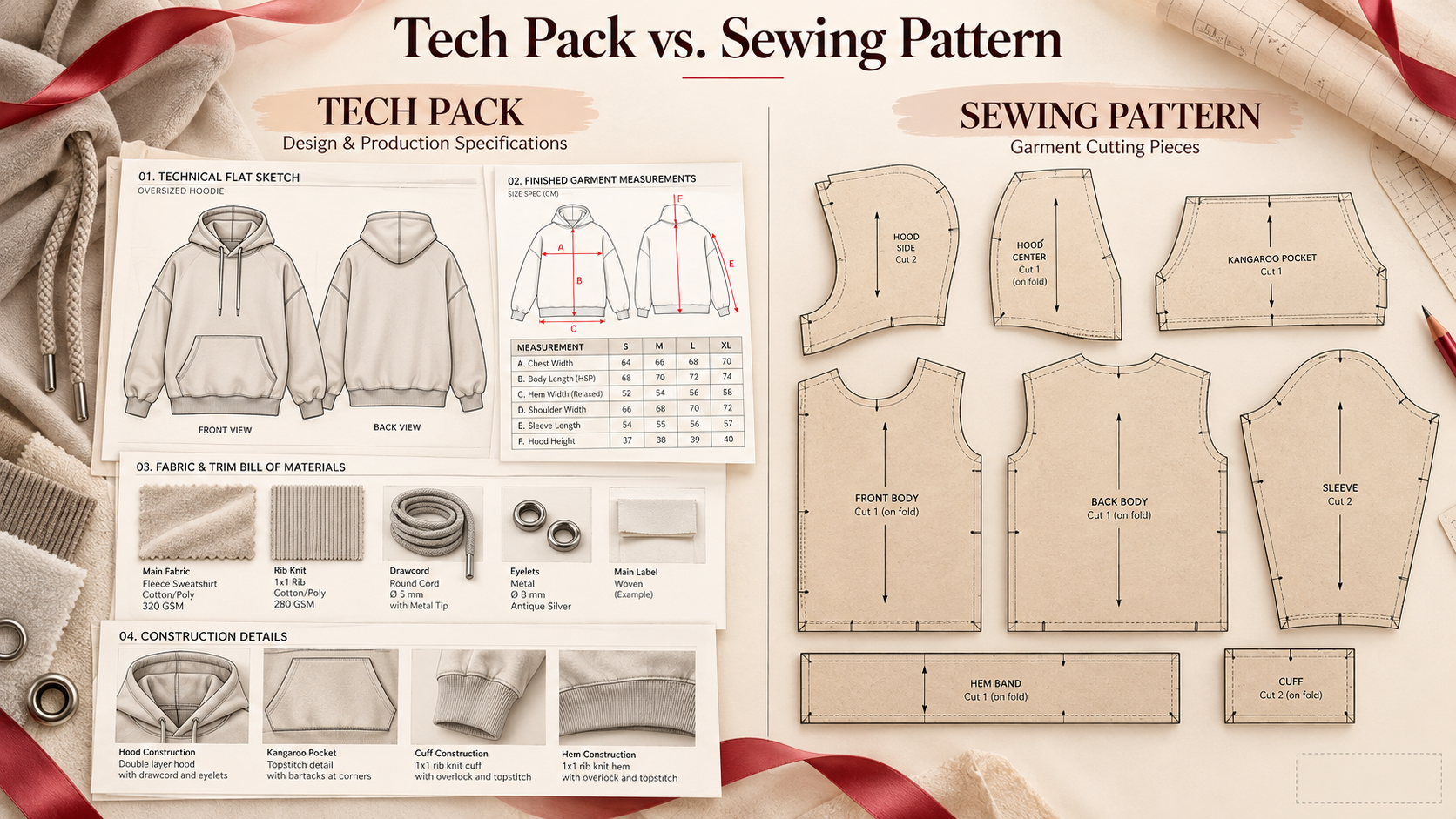
A tech pack and a sewing pattern serve different purposes.
A tech pack communicates how the garment should be made. A sewing pattern defines the shapes used to cut and construct it.
For example, a hoodie tech pack may specify the finished chest measurement.
The sewing pattern determines how the front panel, back panel, sleeves, hood, and other pieces are shaped to achieve that measurement and the intended fit.
Pattern making involves garment construction, fit, ease, and fabric behavior.
It is a separate technical task, even when the same studio offers both services.
Before accepting a quote, ask whether it includes:
- Technical specification documents
- Base-size sewing pattern development
- Pattern grading
- Digital pattern files
- Sample-related pattern corrections
- Additional size specifications
For brands needing more than technical documentation, explore Styliqa's pattern making and grading services.
Hidden Tech Pack Costs to Consider Before Hiring
The initial quoted price may not include every service needed to prepare your garment for manufacturing.
Here are some additional costs worth checking.
Additional Revisions
Some designers include a limited number of revision rounds.
Major changes after approval may cost extra.
Pattern Making and Grading
A tech pack quotation does not automatically include production sewing patterns or grading services.
Confirm these separately.
Extra Colorways
Additional colorways may require updated material specifications, artwork references, or technical illustrations.
Print and Embroidery Artwork
Specifying a logo's location is different from preparing production-ready artwork.
Artwork preparation may be an additional service.
Sample Development Updates
Changes made after reviewing a physical sample may require the tech pack to be updated.
Confirm whether those updates are included.
Fabric and Trim Research
If materials haven't been selected, a designer may need to help identify suitable options.
This research may be outside the initial quotation.
Rush Projects
Some providers charge additional fees for urgent work.
Editable Source Files
A final PDF may be included while editable design files are charged separately.
For a concrete example, GarmentSpec's published pricing information identifies additional fees for services such as extra colorways, revision rounds, and rush turnaround.
The lesson is straightforward: review the complete service scope before comparing final prices.
How to Reduce Tech Pack Costs Without Sacrificing Quality
You don't necessarily need to spend more to improve the quality of your development documents.
Better preparation can reduce unnecessary work.
1. Prepare a Clear Design Brief
Gather your garment reference images, technical sketches, fabric preferences, measurements, and key construction details.
Clearly identify which specifications are confirmed and which still need professional input.
2. Finalize Major Design Decisions
Try to settle the main silhouette, pockets, closures, and other significant features before detailed documentation begins.
Late design changes may require multiple pages of the tech pack to be revised.
3. Group Related Styles
If you're developing a coordinated collection, ask whether shared materials or construction details can simplify the work.
Several styles may use the same labels, trims, or fabric specifications.
This doesn't guarantee a discount, but it can reduce duplicated information.
4. Define the Project Scope
Request a written quotation identifying the documents and services included.
This makes it easier to compare providers fairly.
5. Avoid Unnecessary Services
A simple garment in the concept stage may not need the same level of development as a complex product entering sampling.
Choose services based on your actual requirements.
6. Don't Remove Essential Technical Details
Reducing costs by omitting important construction or measurement information may create problems later.
The objective is to pay for the specifications your manufacturer genuinely needs.
Common Mistakes When Comparing Tech Pack Prices
Choosing Only the Cheapest Provider
A low price isn't automatically a bad sign.
However, an inexpensive service may offer fewer technical deliverables.
Compare the actual documentation before making a decision.
Confusing Technical Flats With Complete Tech Packs
A technical flat shows the garment's appearance and construction features.
A complete tech pack typically includes additional information such as measurements, materials, and construction details.
For a clear comparison, read Styliqa's guide to tech packs and flat sketches.
Assuming Pattern Grading Is Included
A base-size measurement chart isn't the same as a graded sewing pattern.
Ask which grading services are included.
Using Unverified Measurements
Measurements copied from another garment may not produce the desired fit.
Technical specifications should correspond to the actual garment design and be reviewed during development.
Ignoring Revisions
Sample development may reveal necessary changes.
Make sure updated specifications are recorded in the latest version of the tech pack.
Expecting a Tech Pack to Guarantee Perfect Production
A well-prepared tech pack helps communicate product requirements.
However, fabric behavior, sample testing, factory capabilities, and manufacturing quality still affect the final result.
Sampling remains important.
Is a Professional Tech Pack Worth the Cost?
For many clothing brands, professional technical documentation can be a worthwhile part of apparel development.
Consider a simple example.
You send a hoodie reference image to a factory.
The manufacturer produces a sample, but the body length is shorter than expected and the pocket sits too low.
If those dimensions were never specified, the factory may have made assumptions that didn't match your intended design.
A clear tech pack could have helped communicate those requirements before sampling.
This doesn't mean a professional tech pack eliminates every development issue.
Fit adjustments, material behavior, and workmanship still need to be evaluated.
However, technical documentation provides a shared reference that helps designers and manufacturers discuss the intended garment.
It can also be valuable when:
- Working with multiple manufacturers
- Reordering an existing garment
- Expanding a collection
- Developing additional sizes
- Updating approved specifications
- Maintaining consistency between production runs
The value comes from clearer technical communication rather than the document's appearance alone.
How to Choose the Right Tech Pack Designer
Before hiring a technical designer or fashion development studio, ask these questions.
Does the Designer Understand Your Garment Category?
Experience with basic T-shirts does not automatically translate to complex tailoring or technical performance clothing.
Look for relevant garment-development experience.
Can You Review a Sample Tech Pack?
Ask to see examples showing technical drawings, measurement charts, materials, and construction notes.
This can help you evaluate the designer's approach to documentation.
What Exactly Is Included in the Quote?
Request a clear list of deliverables.
Don't assume every provider uses the same definition of a complete tech pack.
How Are Revisions Handled?
Confirm how many revisions are included and what happens when additional changes are requested.
Which File Formats Will You Receive?
Make sure the final documents are compatible with your intended manufacturer's requirements.
Also ask whether editable source files are included.
How Much Does Styliqa Charge for Tech Pack Development?
Styliqa is a fashion design and technical-development studio supporting clothing brands, fashion startups, and apparel businesses.
The studio provides services including technical flat sketches, tech pack development, pattern making, size grading, and 3D garment visualization.
According to Styliqa's official tech pack service page, tech pack and flat sketch projects start from $30 per project.
The website lists Basic, Standard, and Premium options, but the final price depends on the project scope.
The advertised starting price should not be interpreted as the fixed cost of every complete manufacturing tech pack.
For example, a project requiring only technical illustrations may have different requirements from one needing detailed measurement specifications, grading, construction notes, materials, and related development services.
Styliqa works across several apparel categories, including menswear, womenswear, childrenswear, activewear, streetwear, swimwear, formalwear, and workwear.
If you're preparing a collection, you can review the studio's fashion tech pack services and discuss which deliverables your project requires.
How to Request an Accurate Tech Pack Quote
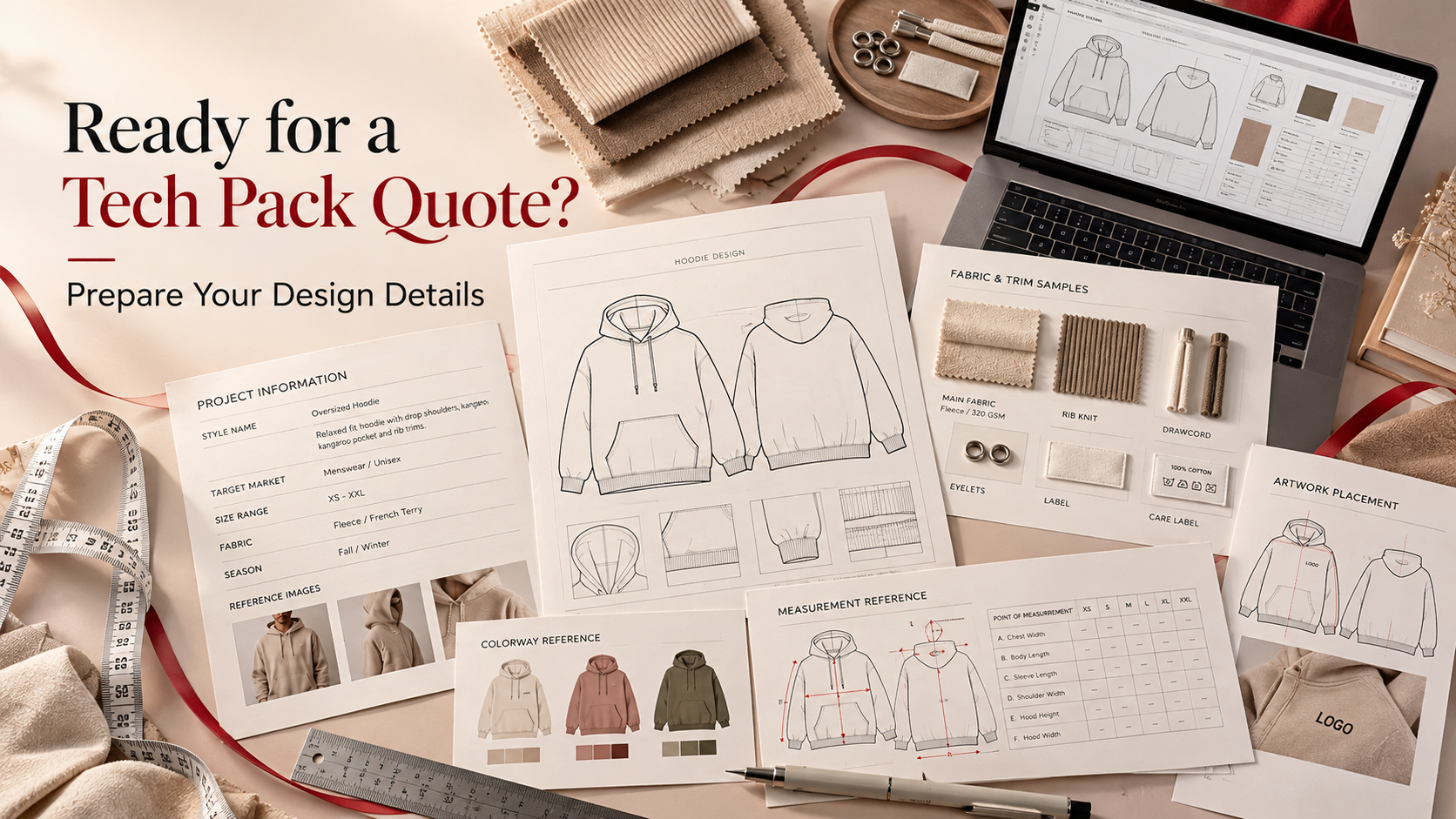
Before contacting a technical designer, prepare a basic project brief.
It doesn't have to be perfect.
The goal is to provide enough information for the designer to understand your garment and development stage.
Tech Pack Quotation Checklist
- Front and back design details
- Garment type and reference images
- Important construction features
- Preferred fabrics and trims
- Base size and intended size range
- Colorways and artwork requirements
- Pattern making or grading requirements
- Target development timeline
- Preferred final file formats
- Revision and sample-update expectations
If you don't know some technical details yet, identify them as questions for the designer.
Clear communication at the beginning can make the quotation process more productive.
Frequently Asked Questions About Tech Pack Cost
1. How much does a tech pack cost for one garment?
A tech pack for one garment may cost under $100 for a limited-scope service or several hundred dollars for comprehensive professional documentation. Complex projects can cost $1,000 or more. Actual pricing depends on garment complexity, technical specifications, and included deliverables.
2. How much does a T-shirt tech pack cost?
T-shirt tech pack pricing varies by provider. TM Tech Packs, for example, publicly lists a $400 package for basic garments. Simpler technical drawing services may cost less, while packages requiring additional specifications or development work may cost more.
3. Can I make a tech pack myself for free?
Yes. You can use free templates, spreadsheets, and design software to create a tech pack. However, you still need the technical knowledge to prepare accurate measurements, material specifications, and construction instructions. All information should be checked before manufacturing.
4. Does a tech pack include sewing patterns?
Not automatically. A tech pack describes garment specifications, while sewing patterns define the pieces used to construct the garment. Pattern making and grading may be separate services. Styliqa offers pattern making and grading support for brands that require these deliverables.
5. Do I need a separate tech pack for every garment color?
Not necessarily. Several colorways can often be included in one tech pack if the garment construction remains unchanged. However, color-specific materials, trims, graphics, and other specifications must be documented clearly.
6. Can I send the same tech pack to different manufacturers?
Generally, yes, provided you have the necessary rights to use and share the documents. A well-prepared tech pack can help multiple manufacturers review the same garment specifications. However, individual factories may request additional information.
7. How much does Styliqa charge for a tech pack?
Styliqa currently advertises tech pack and flat sketch projects starting from $30 per project. Final pricing depends on the garment and required technical services. Clothing brands can contact Styliqa for a project-specific quotation.
Final Thoughts: How Much Should You Spend on a Tech Pack?
Tech pack cost varies because not every clothing product requires the same level of technical development.
A limited-scope technical service may cost less than $100, while a detailed professional tech pack can cost several hundred dollars or more.
The right budget depends on your garment's complexity, required specifications, and manufacturing goals.
Instead of comparing prices alone, focus on what's included.
Review the technical drawings, measurement specifications, construction details, materials, revision policy, and final file formats.
A well-prepared tech pack helps communicate your intended garment and provides a valuable reference throughout development.
For clothing startups, that clarity can be more important than choosing the lowest advertised price.
Need a Professional Tech Pack for Your Clothing Brand?
Preparing a garment for manufacturing takes more than an attractive design.
Clear technical drawings, accurate measurements, and organized production specifications help communicate your requirements to manufacturers.
Styliqa supports fashion startups and clothing brands with professional tech pack development, technical flat sketches, pattern making, grading, and related fashion technical-development services.
If you're preparing your first garment or developing a new collection, share your design references and production requirements with the studio.